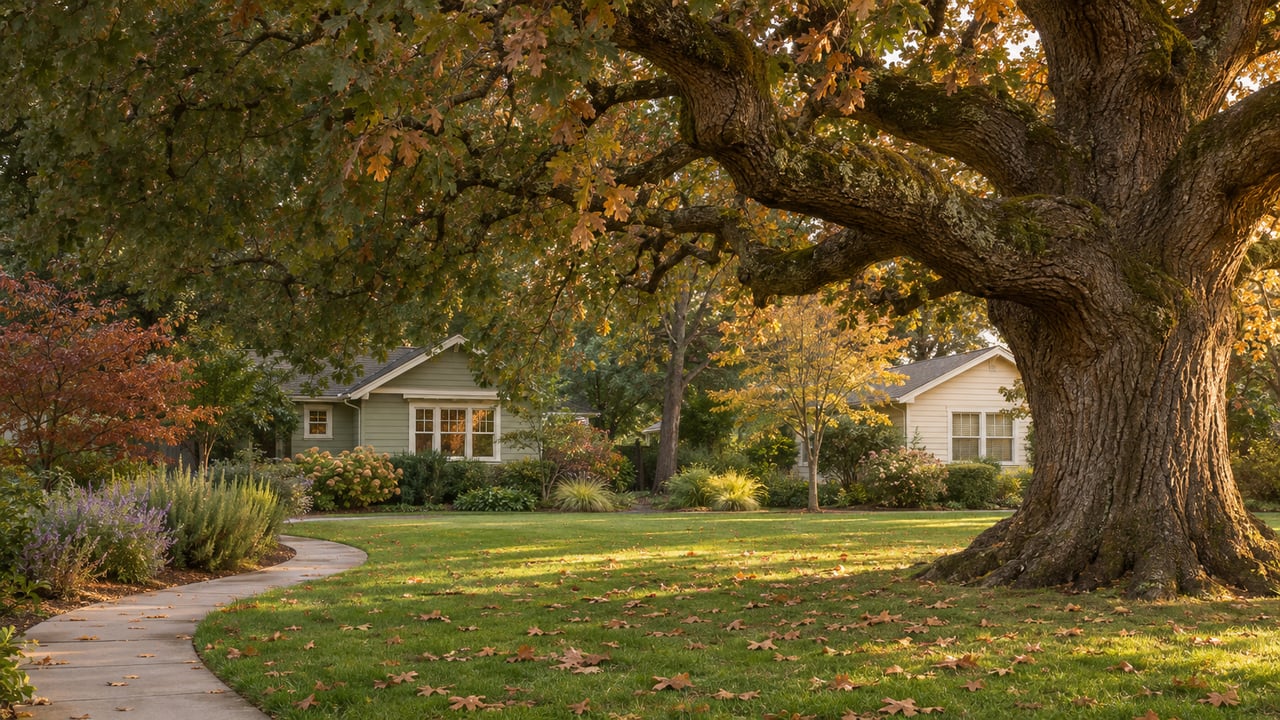
Windsor's History Museum Is in a Subdivision. So Is Most of Windsor's History.
November 12, 2026
November 12, 2026
On Foxwood Drive, inside the Alden Wood subdivision, a row of tall cypress trees stands across the street from a white Spanish-style house. The trees once lined a ranch driveway. The house is the Windsor Historical Society's museum, the Hembree House, at 9225 Foxwood Drive. It is open Friday through Sunday from 11 a.m. to 2 p.m., and admission is free.
Windsor didn't incorporate until 1992, so it can seem like a town without much history. But a lot happened here before 1992, and most of it took place on land that is now cul-de-sacs, grocery parking lots and the roads people use to get to the freeway. The museum is the best key to that map. Society president Steve Lehmann told The Press Democrat this summer, "If I had a dollar for every time someone says they didn't know we existed, we would never have to hold another fundraiser."
The house is on the east side of Highway 101, next to the senior center off Foxwood Drive. The Society dates it to 1931. Clara Hembree and Dr. Atlas Hembree built it as their retirement home on ranch land her grandfather, Robert Cunningham, had homesteaded in the early 1850s.
The property's later owners follow the way Windsor itself changed. It stayed in the family for more than 100 years and was then sold to the William Matson Roth family. Next came the Mabry family, who started Landmark Winery there. As houses spread into the vineyards, the winery moved away. The Windsor Water District bought the house, and it eventually went to the Town of Windsor. The museum opened in February 2009.
That history explains the odd location. The neighborhood grew up around a ranch house.
The cypress trees make the old layout easy to picture. In The Press Democrat's August story, the house's front door still faces the line of the old driveway, which once ran all the way to where Oliver's Market is today. A Press Democrat piece from May says the driveway started at Old Redwood Highway and crossed land where Highway 101 now runs. Several of the trees still stand outside the museum.
The Cunningham House sits behind the Hembree House. It is the much older home that grew out of the family's first timber house. Somewhere between that cabin and the Hembree home, the family planted 60 acres of prune trees, back when prunes were the main crop in the area. A traditional prune box sits on the path between the two houses. Lehmann described how the harvest worked, with a heated tub of lye water, the "dipper," lit each morning and kept running through the whole harvest so fresh fruit could be dipped before it was laid out to dry.
The Cunningham House is under repair. In August, The Press Democrat reported that its old foundation was failing and the house was cracking in two. The house was resting on blocks while crews carefully laid a modern cement foundation under it. If you visit, you'll see a restoration in progress next to a house that has already been restored.
The museum's exhibits connect to places Windsor residents pass all the time. Here is how some of them line up.
| Where you are today | What the museum's record places there |
|---|---|
| Oliver's Market | The far end of the Cunningham Ranch driveway lined with cypress |
| Foxwood Drive, Alden Wood | The Cunningham homestead, its prune orchard and the Hembree retirement home |
| The present-day Standard Structures site | Grant Laughlin's ranch, where Fred Wiseman and mechanic John Peters built and tested their first airplane |
| Windsor River Road, just before Eastside Road | Camp Windsor, a World War II prisoner-of-war camp |
| Wohler Bridge | Named for the Wohler Ranch, a 1,500-acre hop ranch |
The museum's cases fill in each row.
The Hembree House is about 3,000 square feet. Most of the exhibits fill two rooms with wood floors, and a third room is a gallery.
Hops are the history that changed the land the most and left the fewest traces. Lehmann told The Press Democrat this:
"There used to be walls of green and yellow that lined the Russian River, causing River Road to be canyon-like."
He said the industry peaked in the 1950s before moving to the Central Valley and then to Washington state. At harvest, the Wohler Ranch, which gave Wohler Bridge its name, hired 1,400 workers and dried the crop in an eight-stack kiln. The ranch set up a small town in the fields with housing and stores, and butchers from town drove their wagons out to sell to the camps every day.
The museum keeps some of that crop growing. The heritage patch facing the road comes from a plant first set out in the 1940s. A second patch grows behind the house, beside a concrete pad. The Society's events page says its hop yard was propagated from bines more than 70 years old, taken from the historic hop yards that once dotted the Russian River valley. The public harvest happens in late summer, so a November visit shows the yard after the harvest is over.
The Society's Hands on History series ends on Saturday, November 21, with "Clothes to Quilt." The program covers clothing from the period, how it was made and how families reused valuable fabric. The series is aimed mainly at kids. Nancy Hazen, who created the series, told The Press Democrat that most people then owned three sets of clothes, "two sets of work clothes and one set of nice clothes." For the start time, call the Society at 707-838-4563 or email [email protected].
The Society also holds a holiday party every December to thank the community, with light refreshments. The same phone number and email will have this year's date.
The museum has one more stop, and it's outside. The Society publishes a self-guided downtown walking tour that shows old Windsor along Windsor River Road, the part of town that came before the Town Green. In the order you would reach them walking east from Windsor Road, the brochure lists these stops:
To make an afternoon of it, start at Foxwood Drive any Friday, Saturday or Sunday between 11 and 2, then drive west across the freeway to Windsor River Road with the brochure. The Society also takes research visits by appointment.
Joe has spent years in Sonoma County, including board service with the Boys and Girls Club of Greater Santa Rosa, and he'd be glad to hear which part of Windsor's past you spot first on your next drive down Windsor River Road. If you're curious about the history behind a particular street or property, Joe Henderson Real Estate is happy to talk it through. Let's Connect.
Stay up to date on the latest real estate trends.
Work with Joe Henderson and experience the difference of true professionalism and consistency in service. Your goals are our mission—partner with Joe for a seamless, rewarding real estate journey.